
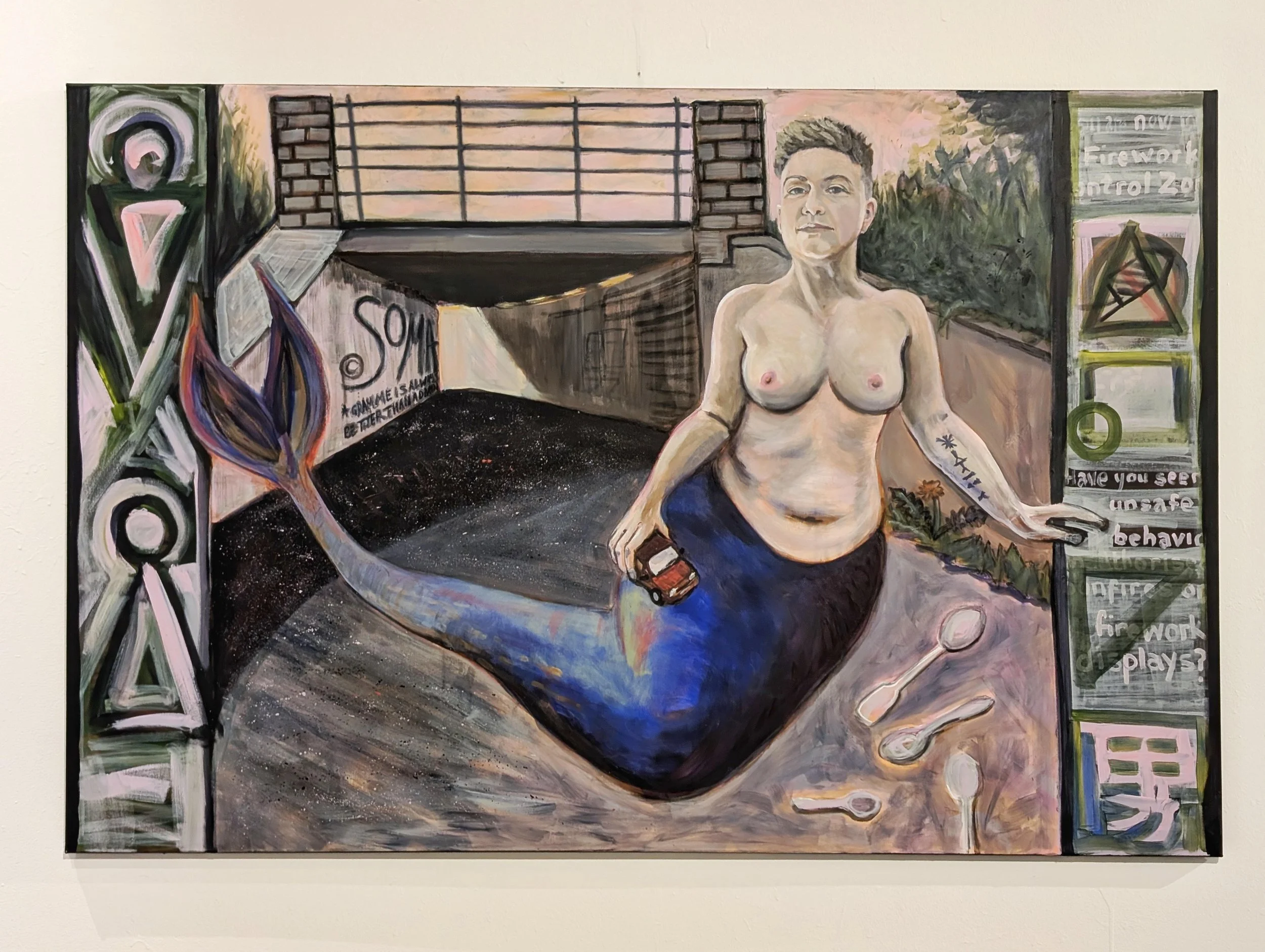
Self portrait as the Bingham Mermaid
Acrylic on canvas
I found lockdown quite difficult to come out of and as part of that I signed up to an Adult Education ‘Sketching Edinburgh’ course. We were just going around all these beautiful closes off the Royal Mile and it’s just like being in Disneyland. And Edinburgh’s really bad for that- it’s just like let’s push everything that we don’t want people to see to the outskirts but actually there are really exciting things happening in these communities that have been pushed out where no one sees them. And it’s not necessarily the story that the powers that be want to tell.
What I set out to do (in the exhibition) is challenge the view of Craigmillar that I grew up with. Growing up it was just an area that you stayed clear of- if you heard about it was because riots were happening. Drugs, violence, crime. When you’d drive through- and you can see this and I find this really offensive- the traffic lights have cages around them- you know- how does that make an area look? It doesn’t exactly scream friendly, cuddly, welcoming….. And then I moved to the area about seven years ago and I couldn’t reconcile these two ideas- and I started to learn so much about the history of the place and the Craigmillar Festival Society. I thought why did I not grow up knowing about this- I grew up in this city- why did I not know about the Craigmillar Festival Society and Helen Crummy and all these amazing things that were happening because it’s globally important. This was groundbreaking….
As I see it the Bingham mermaid was a piece of protest art within my community. I live just on the other side of this underpass here (in painting). In the late 70s there was a proposed motorway that was going to be routed through Bingham that the locals were against. The Craigmillar Festival Society had money that was independent of the council, and they commissioned Pedro Pablo Silva, a New York artist to come over and design this sculpture. He had the idea that the community would build it together and it was a sixty foot long, twenty foot high concrete sculpture of a mermaid. A beautiful, colourful mermaid that lay across the path of the motorway. And the way I see it, she was successful as to this day, there are no motorways in Bingham! I just think the power of something kind of so beautiful makes me think of sirens, you know mermaids aren’t always fragile like Arielle from the little mermaid, they can have a real strength, an animalistic strength. And I love that people in the community were involved in the building as well and I think that’s really, really important in community art and that people shouldn’t have art imposed upon them.
So obviously there’s the story in my painting of the Bingham mermaid that’s all about identity. It’s kind of a response to expectations that I perceive of beauty or body standards. It’s an expectation that I feel that I should feel ashamed. And I know it’s widespread, everyone feels it, even people who are perceived by others as having a perfect body and a youthful figure and this is what I’m expressing. As sort of like a defiance against this - that I should feel shame about my mental health, about the fact that I’ve given birth…, my body looks like I’ve given birth. I’ve had children, I’m 45 ….. and actually that saggy belly is beautiful! I refuse to be told otherwise, I refuse to accept that. And often this shame that’s forced on me actually starts to grow a bit, and then I’m like that’s not what I think actually. By painting myself as this sculpture I can show what I see as important and represent who my community are. I can give myself even more of a feeling of belonging by sort of wedging myself in this creation myth. I never got to see this mermaid as it was demolished in 1987. And by the end she’d become really dilapidated and had become this haven for drug use and glue sniffing from accounts that I’ve heard. So to me it’s like this mythological creature- it’s not a concrete sculpture. This mermaid was summoned up from the sea to protect the community. There’s definitely something a bit sort of fantastical about the painting.
I identify as AuDHD where autism and ADHD come together in quite a distinct way. Different from autism on its own or ADHD on its own. In regard to mental health- my mental health is really affected by seeing all the awful and horrific things happening around the world and feeling this loss of control that there’s nothing I can really do to help and it’s a really difficult thing to live with. Since my teens I’ve been on and off medication for my mental health and sometimes I try to come off it ….it’s like Brave New World this dystopian book about the future they all took Soma this medication to just ignore all bad things happening in the world and just to subdue them and keep them quiet and stop them reacting and I very much have this conflicted relationship with my medication as I feel like that’s happening to me but I also feel that I can’t because I need it to survive so there’s a definite push/ pull. In the painting there’s ‘Soma’ written on the wall ‘A gramme is always better than a damn’ from Brave New World talking about Soma. The copyright sign references Basquait’s graffiti tag SAMO, or ‘same ol’ shit’. It’s generally about identity.
The panel at the side of the painting says, ‘you’re now entering a firework control zone’. In this area we’re famous for our fireworks displays- we’ve been on the news a few times for the disorder and the fireworks which is really quite upsetting. I hate fireworks- well I love an organised fireworks display- but this and not knowing when it can happen is traumatic, particularly for veterans in the area, and for dogs. It’s associated with violence and disorder, and the fireworks come hurtling down the street from about 4pm for about a month- horizontally fired by youths. However, I’m even less happy about being placed in a firework control zone. How dare they label a whole area like that. How dare they label other people and punish them for where they live. And horrible comments on social media slamming my community. I do think there should be fireworks controls in the city as a whole- but you can’t go picking on communities like that. I think it’s outrageous.
The biggest thing I learnt (preparing for exhibition) is what is important in community, and that would be connections. I think that there are certain people that go above and beyond, and that they are disproportionately important in the community. By forming connections with people, they then connect everyone together outwards in this grassroots culture. This feeling that comes, I think, from Helen Crummy and the Craigmillar Festival Society, of ‘Make It Happen’, that sense of pride and boldness. The grassroots thing is so important as help that does come from outside is first of all disconnected, as there are assumptions that are made, and it’s really easy to miss the mark. Even if (support) is spot on, again there’s this sense of being patronised and it’s really hard to avoid that coming from an external point of view… It can be so hard to gain those relationships and trust with people, whereas when the support is peer to peer it just connects in a way that nothing else really can. One of the things that is really special, is just how many different grassroots organisations there are in this area.
https://www.craigmillarnow.com/craigmillar-art-trail/project-one-f5w4d-sbpek-atzxl-g7pfg-bhf4a